Have Foreign Institutional Investors (FIIs) finally turned buyers again? Or is this just a temporary shift driven by easing geopolitical tensions?
Over the past two weeks, markets have shown early signs of renewed FII interest. But the real question for investors is—what’s driving this change, and how sustainable is it?
Is the easing of US–Iran tensions changing the game?
Global markets have been on edge due to rising tensions in West Asia. The risk was clear—any disruption in the Strait of Hormuz could push crude oil prices sharply higher.
Now, with signs of de-escalation, oil prices have stabilised.
But does that automatically translate into FII inflows?
Not entirely—but it certainly improves the backdrop.
Lower oil volatility reduces inflation fears for India. It stabilises the rupee. And it makes India more attractive compared to other emerging markets. That’s often enough to bring FIIs back—at least selectively.
So, how much money has actually come in?
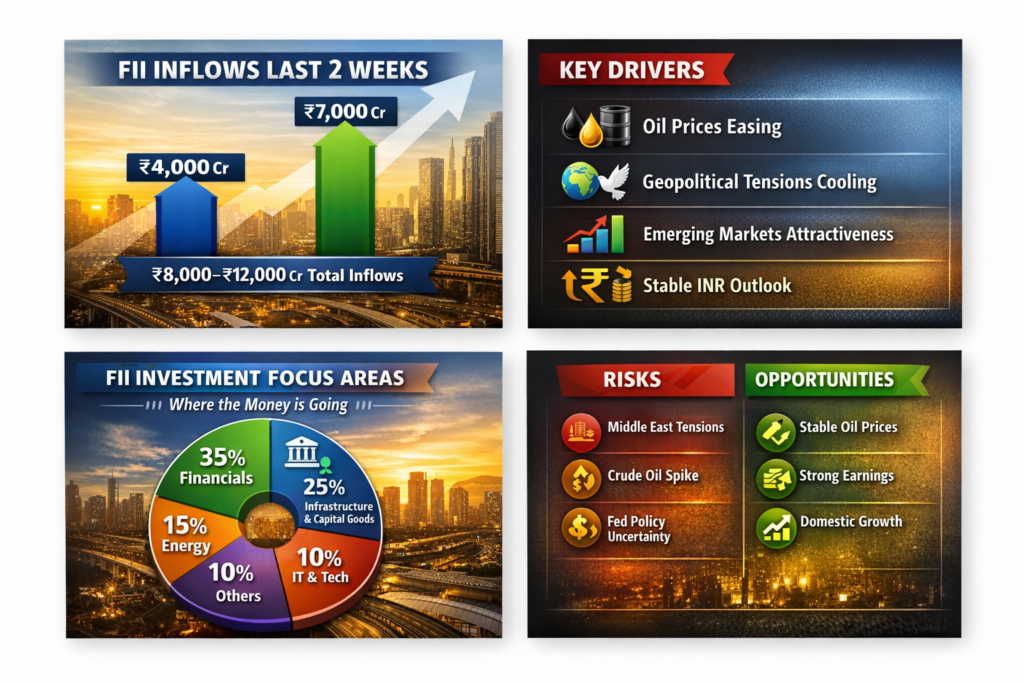
Recent trends suggest FIIs have turned modest net buyers, with estimated inflows in the range of ₹8,000–₹12,000 crore over the last two weeks.
But here’s the catch—this is not aggressive buying.
It’s cautious. Gradual. Tactical.
Which raises another question.
Where exactly are FIIs putting their money?
They are not chasing momentum. They are choosing stability.
Financials are leading the pack. Strong balance sheets and consistent earnings make banks a natural choice in uncertain times.
Capital goods and infrastructure are also seeing interest. Why? Because India’s capex story remains intact, regardless of short-term global noise.
Energy stocks are getting selective attention. This may look counterintuitive with oil stabilising, but it reflects hedging behaviour.
IT, after a phase of correction, is seeing selective buying due to attractive valuations.
So, is this a broad rally? Not really.
It’s a focused allocation strategy.
What are FIIs really betting on?
Is it geopolitics alone? Or something deeper?
The answer lies in a combination of factors:
- Cooling global risk perception
- Stable macro environment in India
- Earnings visibility in large-cap sectors
- Relative attractiveness versus other emerging markets
In short, FIIs are not just reacting—they are rebalancing.
Should investors read this as a strong bullish signal?
Not so fast.
If FIIs were fully convinced, flows would be much stronger and more widespread. Instead, what we’re seeing is measured optimism.
They are:
- Preferring large caps
- Avoiding high-risk segments
- Staying alert to global triggers
This suggests confidence is improving—but not fully restored.
What could change the trend from here?
Ask yourself:
- What happens if crude oil spikes again?
- What if geopolitical tensions flare up once more?
- How will US Fed policy impact global liquidity?
These are the variables FIIs are watching closely.
What does this mean for Indian investors?
Instead of reacting to short-term flows, investors should focus on what FIIs are signalling through their choices.
They are leaning towards:
- Stability over speculation
- Earnings over narratives
- Scale over risk
That’s a useful cue.
The bigger question
Are FIIs back for the long term—or just testing the waters?
The answer will depend on how global risks evolve. For now, the message is clear:
👉 The worst of risk aversion may be behind us
👉 But conviction is still building
For investors, this is not a time for blind optimism.
It’s a time for informed positioning.