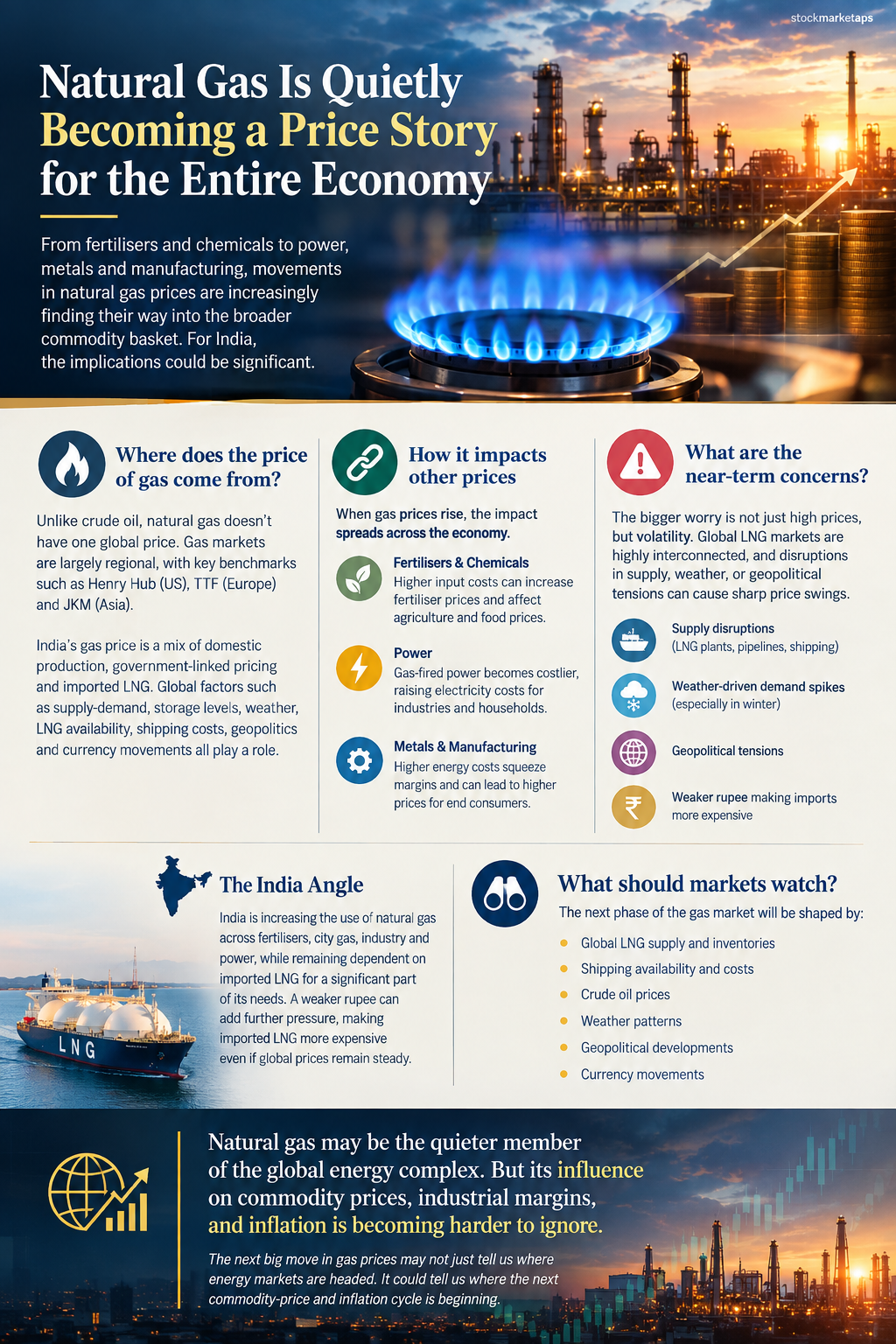
From fertilisers and chemicals to power, metals and manufacturing, movements in natural gas prices are increasingly finding their way into the broader commodity basket. For India, the implications could be significant.
Natural gas does not command the same attention as crude oil. Yet, when its price moves sharply, the consequences can travel far beyond the energy market.
That is because gas sits at the heart of several industrial value chains. It is a source of energy for factories, a feedstock for fertiliser and chemical production, and an increasingly important fuel for power generation, city gas distribution and other industries.
In other words, the price of natural gas can become the price of many other things.
Where does the price of gas come from?
Unlike crude oil, natural gas does not have one universal global price. Gas markets are largely regional because moving gas requires pipelines or liquefaction and shipping infrastructure.
The US market looks primarily to Henry Hub, Europe to TTF, while Asian LNG markets closely track the Japan Korea Marker (JKM). Long-term LNG contracts in Asia can also be linked to crude oil benchmarks.
India’s gas market is a combination of domestic production, government-linked pricing mechanisms and imported LNG. Consequently, domestic consumers can be exposed to global price movements even when India’s own gas production remains relatively stable.
The drivers are familiar but powerful: supply-demand balances, storage levels, weather, LNG availability, shipping costs, geopolitical disruptions and currency movements.
The important point is that gas pricing is no longer simply an energy-sector issue.
The commodity chain starts reacting
Consider fertilisers.
Natural gas is a critical feedstock for producing ammonia, which forms the basis of several nitrogen fertilisers. When gas prices rise, production economics for fertiliser manufacturers come under pressure.
The impact does not necessarily stop at the factory gate. Higher input costs can influence fertiliser prices, government subsidy requirements and, eventually, farm economics.
The same transmission mechanism exists across industries.
For a glass manufacturer, ceramics producer, steelmaker, chemical company or other energy-intensive business, gas is part of the cost structure. If energy costs remain elevated, companies eventually have to choose between absorbing the increase, cutting production or passing the cost to customers.
That is where gas begins to acquire an inflationary character.
The transmission may be slow, but it can be broad.
Power is another critical transmission channel
Gas-fired power generation is particularly sensitive to fuel prices. When gas becomes expensive, generating electricity from gas becomes less competitive against alternative sources.
For businesses already dealing with higher electricity, logistics and raw-material costs, another increase in energy prices can squeeze margins.
This creates an interesting market dynamic.
Companies may report stable revenues while profitability comes under pressure because input costs are rising faster than selling prices. For investors, therefore, tracking natural gas prices can provide clues about future EBITDA margins in some energy-intensive sectors.
What happens if the pressure persists?
The bigger concern for markets may not be a temporary spike in gas prices, but sustained volatility.
Global LNG markets are becoming increasingly interconnected. A supply disruption in one part of the world can quickly influence prices elsewhere. Weather can create sudden demand spikes, while geopolitical tensions can affect pipeline supplies, LNG shipping routes and availability.
Europe’s energy crisis demonstrated how quickly an energy shock can become an industrial competitiveness issue.
For India, the vulnerability is different but equally relevant. The country is expanding the use of natural gas across fertilisers, city gas, industry and other applications, while remaining dependent on imported LNG for a significant portion of its requirements.
Currency movements add another layer. A weaker rupee can make imported LNG more expensive even if the international dollar price remains unchanged.
The market is therefore watching more than Henry Hub or TTF
The next phase of the gas market will be determined by several variables moving simultaneously: global LNG supply, inventories, shipping availability, weather, crude prices, geopolitical developments and currency movements.
For corporate India, this means natural gas should increasingly be viewed as a strategic input cost rather than simply another commodity price.
For investors, it can offer an early signal of pressure building across industrial margins.
And for policymakers, the equation is even broader: expensive gas can feed into energy costs, fertiliser economics, industrial production and inflation.
Natural gas may remain the quieter member of the global energy complex.
But its influence is becoming harder to ignore.
The next big move in gas prices, therefore, may not just tell us where energy markets are headed. It could tell us where the next commodity-price and inflation cycle is beginning.